Book Resources

purchase

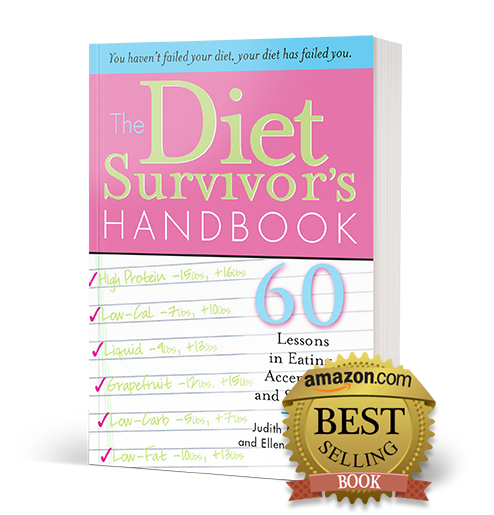
The Diet Survivor’s Handbook: 60 Lessons in Eating Acceptance and Self-Care

newlessonsnote

NEW LESSONS

"Every soul has to learn the whole lesson for itself. It must go over the whole ground. What it does not see, what it does not live, it will not know." – Ralph Waldo Emerson

Look for a new lesson with the start of each season.


NEW LESSON: WINTER 2012

Pay more attention to your fullness. The sooner you stop eating, the sooner you will get to start again.

Most people report that as they normalize their eating, they have an easier time starting when they are hungry than stopping when they are full. In the past, part of the reason you overate is because of your belief that once you stopped eating something—usually a "forbidden" food—you would not be able to have it again. Remind yourself constantly that this is no longer the case. If you eat a cookie now, and crave one again in half an hour, you will have it! This type of reassurance allows you to calm down and feel safe when you contemplate stopping. In fact, it is very helpful to remind yourself that the sooner you stop eating, the sooner you will get to eat again!

Read more: Winter 2012

NEW LESSON: FALL 2011

Stay curious about your mouth hunger. Think of yourself as a detective as you try to learn more about what leads you to reach for food when you are not physically hungry.

Whenever you experience repeated mouth hunger, check in with yourself to see if you have the basic steps of the approach in place. Are you tuning into hunger and fullness? Are you asking yourself exactly what would satisfy your hunger? Are you keeping a wide variety of food available? Are you judging food as "good" or "bad"? Often, a simple adjustment in one of these areas is enough to solve your problem and help you return to attuned eating. If, however, these guidelines are in place and you continue to reach for food when you are not physically hungry, think of yourself as a detective as you examine the meaning of your eating. Use the phrase you learned previously, "I'm reaching for food and I'm not hungry. I wonder what I would think about or feel if I didn't eat right now." If you're able to postpone your reach for food, you have a wonderful opportunity to look at what is truly going on for you at that moment.

Read more: Fall 2011

NEW LESSON: SUMMER 2011

Become aware of how you speak about your body in front of your children. The way they feel about their own bodies is strongly affected by the messages of important people in their lives.

Children are born into the world without preconceived notions about thin and fat. They find joy in the pleasure of their body and its capacities. Yet sooner or later they will be exposed to the cultural messages that they must stay thin to be accepted. How they respond to these messages is strongly affected by what they learn at home.

Read more: Summer 2011

NEW LESSON: SPRING 2011

Consider what you are hungry for before you look at what is available. Listening to your internal cues will help you to make more satisfying matches.

It is not uncommon for people to open their refrigerators or cabinets as they muse, "What do I want to eat?" After seeing the options available, a choice is made that may or may not serve as a good match. The problem with this method is that it constricts people to picking foods that are immediately available, without giving enough thought to internal signals that can help direct food selection.

Read more: Spring 2011